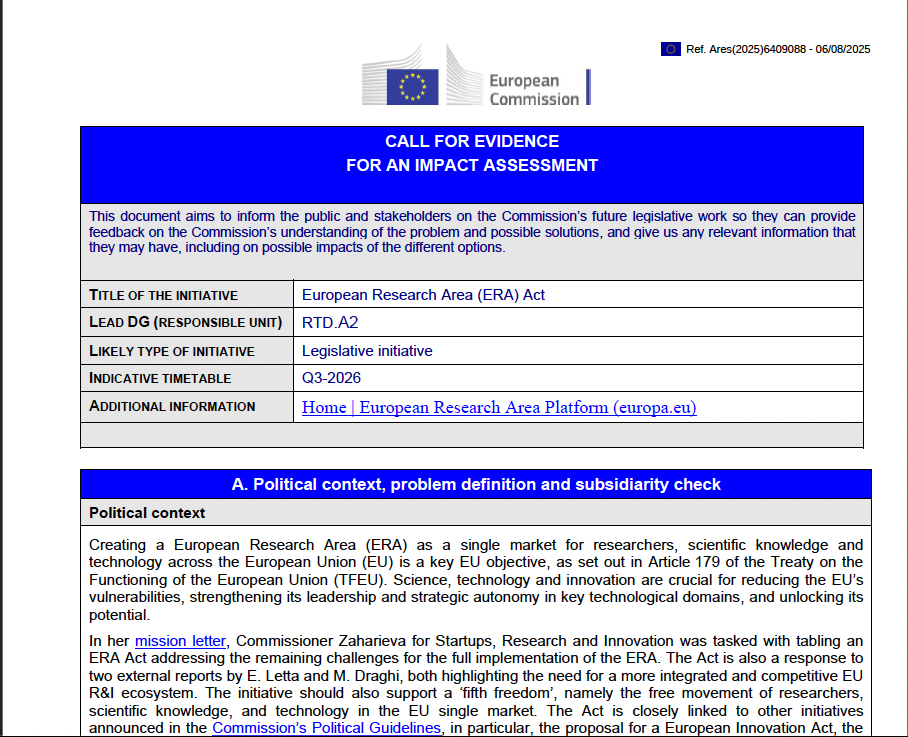
The European Commission has opened a Call for Evidence on a forthcoming European Research Area (ERA) Act, a legislative initiative aimed at transforming the EU’s research and innovation landscape into a more integrated, competitive, and resilient system. The initiative, led by the Directorate-General for Research and Innovation (DG RTD.A2), is scheduled for adoption in the third quarter of 2026.
A Unified Research Space for Europe
The proposed ERA Act seeks to establish a genuine single market for researchers, scientific knowledge, and technology across the European Union — a goal enshrined in Article 179 of the Treaty on the Functioning of the EU (TFEU). By addressing persistent fragmentation, uneven R&D investment, and barriers to researcher mobility, the Act will help strengthen Europe’s scientific leadership and strategic autonomy in key technologies.
The initiative is a direct response to recommendations made in the reports of Enrico Letta and Mario Draghi, which underscored the need for a more cohesive and competitive research and innovation ecosystem. It also supports what has been described as the EU’s “fifth freedom” — the free movement of researchers, knowledge, and technology — complementing the freedoms of goods, services, capital, and people.
Tackling Systemic Barriers
Despite progress achieved through voluntary cooperation, Europe continues to fall short of the long-standing 3% of GDP R&D investment target. Fragmented national systems, uneven recognition of qualifications, and administrative obstacles to researcher mobility continue to hamper progress. Moreover, early-career scientists often face precarious employment and limited opportunities, reducing Europe’s capacity to attract and retain talent.
The ERA Act will address these issues through binding commitments, improved framework conditions for research careers, open access to publicly funded results, and strengthened cooperation between universities, research organisations, and industry.
Legislative Priorities and Key Measures
The Act will focus on three main policy blocks:
- National commitments to reach the 3% R&D target, with mechanisms to stimulate both public and private investment.
- Better alignment of investments and policies, ensuring coordination between EU and national research agendas.
- Improved framework conditions for research and researchers, including:
- Enhanced mobility and career development opportunities.
- Stronger guarantees for academic freedom, research ethics, and gender equality.
- Greater coherence in international cooperation and research security.
The initiative will be backed by an impact assessment, due to conclude by late 2025, and extensive stakeholder consultations through the ERA Forum and European Research Area and Innovation Committee (ERAC).
Wide Consultation to Inform the ERA Act
The Commission is calling on national and regional authorities, research institutions, higher and vocational education providers, private companies, and scientific organisations to contribute evidence, data, and policy recommendations. This consultation aims to capture insights on the challenges facing the ERA and potential legislative solutions.
Specific consultation milestones include:
- A targeted dialogue with the ERA Forum on 4 April 2025.
- A strategic debate at the ERAC Plenary on 12 June 2025, under the theme “ERA: From Ambition to Action”.
- A 6-week public feedback period through the “Have Your Say” portal, followed by a 12-week public consultation.
Strengthening Europe’s Innovation Leadership
Once adopted, the ERA Act is expected to benefit over two million researchers in the EU, making Europe a global hub for scientific excellence and innovation. By improving coordination, increasing funding, and safeguarding the freedom of scientific research, the initiative aims to close the innovation gap with other global powers, boost the EU’s competitiveness, and reinforce its position as a leading destination for talent and investment.