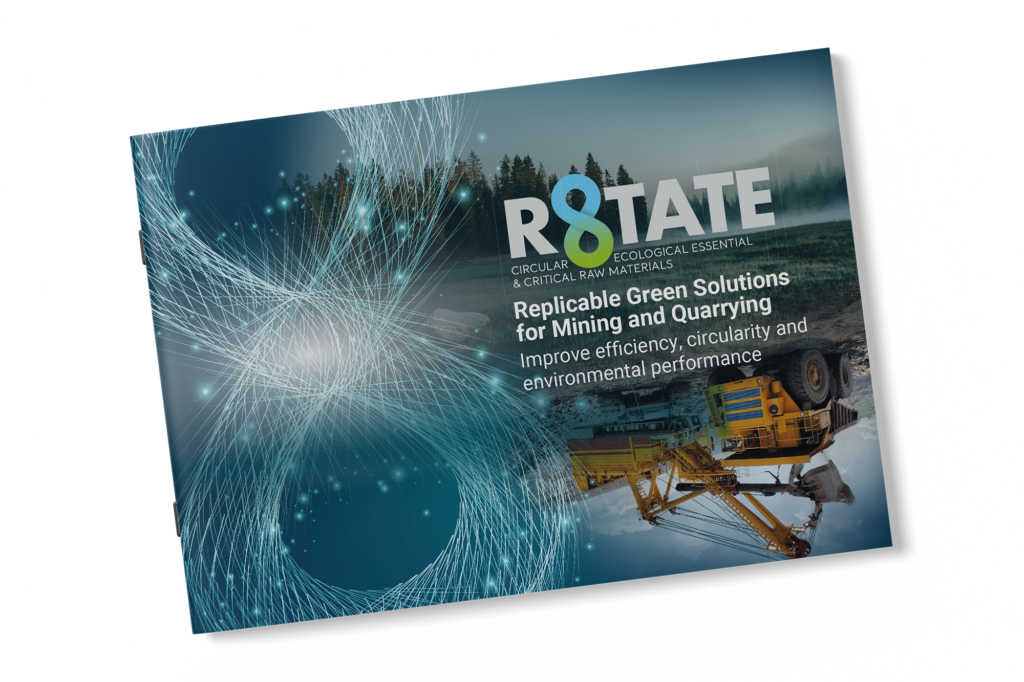
The European Horizon Europe project ROTATE, funded by the European Commission and coordinated by ANEFA (Aggregates – Spain), has officially presented its final catalogue of innovative, replicable solutions designed to enhance sustainability, efficiency, and circularity in mining and quarrying operations.
This comprehensive document, titled “Replicable Green Solutions for Mining and Quarrying: Improve efficiency, circularity and environmental performance”, brings together the main outcomes of the project, showcasing a wide range of practical tools, technologies, and methodologies developed and validated throughout the ROTATE initiative.
The catalogue reflects the collaborative work of the project consortium and offers industry stakeholders practical, ready-to-implement solutions to key environmental and operational challenges in the extractive sector.
A holistic approach to sustainability
The solutions presented in the catalogue are structured around four main pillars: efficiency boosters, circularity enhancement, monitoring and assessment tools, and environmental and community stewardship instruments.
Under the efficiency pillar, the project has developed advanced technologies to improve operational performance and reduce environmental impacts. These include innovations such as noise and dust minimisation systems for mobile crushers, energy-based crushability characterisation methods, and AI-driven granulometry monitoring systems capable of reducing energy consumption and CO₂ emissions in crushing processes.
Driving circular economy solutions
A significant part of the catalogue focuses on circular economy approaches, demonstrating how mining and quarrying residues can be transformed into valuable resources. Examples include the valorisation of aggregate washing residues into construction materials, the reuse of sludge for 3D printing applications, and the application of end-of-waste criteria to facilitate the commercialisation of secondary raw materials.
These solutions not only reduce waste and landfill dependency but also contribute to lowering the environmental footprint of the sector while creating new economic opportunities.
Advanced digital tools for decision-making
One of the core achievements of the ROTATE project is the development of an integrated digital ecosystem to support decision-making and environmental management.
At the centre of this ecosystem is the ROTATE platform, a web-based tool designed to assist operators in improving environmental performance through a series of interconnected modules, including energy efficiency, emissions estimation, biodiversity management, and risk assessment.
Additional tools, such as the Plantsmith module for generating Environmental Product Declarations (EPDs) and life cycle assessments, further strengthen the capacity of companies—particularly SMEs—to comply with regulatory requirements and improve transparency.
Supporting environmental and social responsibility
Beyond technical solutions, the catalogue also highlights a set of strategic guidelines aimed at strengthening environmental governance and social acceptance within the sector.
These include biodiversity indicators, corporate social responsibility (CSR) frameworks, community engagement strategies, and guidelines on gender equality. Together, these tools support companies in aligning their operations with European environmental policies, ESG principles, and societal expectations.
A reference for the future of the extractive sector
The final catalogue represents a key milestone for the ROTATE project and a valuable reference for the mining and quarrying industry across Europe. By combining technological innovation, environmental stewardship, and social responsibility, the project contributes to the transition towards a more sustainable, resilient, and competitive extractive sector.
With its practical orientation and replicability, the ROTATE catalogue is expected to play a crucial role in facilitating the adoption of best practices and accelerating the implementation of green solutions throughout the value chain.