A new scientific paper published in the prestigious journal Minerals Engineering highlights significant advances in the sustainable processing of critical raw materials, reinforcing the research objectives of the European project ROTATE. The study, entitled “Optimized Multi-Stage Gravity Separation Strategy for Celestine Beneficiation Based on Integrated Characterization and Process Simulation”, presents an innovative methodology to improve the recovery and upgrading of celestine (SrSO₄), the primary mineral source of strontium.
The research focuses on the Montevive deposit in Granada (Spain), which hosts the largest strontium reserve in Europe and is part of the only active celestine-producing region within the European Union. Strontium has been identified by the European Commission as a Critical Raw Material due to its growing importance in strategic industrial applications, including electronics, permanent magnets, specialty glass, pigments, ceramics, drilling fluids and advanced manufacturing technologies.
The study was carried out by researchers from Canteras Industriales and the University of Granada, with financial support from the ROTATE project (Grant Agreement No. 101058651), funded by the European Union’s Horizon Europe Programme. ROTATE is coordinated by ANEFA (National Association of Aggregate Producers of Spain) and brings together a multidisciplinary consortium committed to promoting the circular use of mineral resources and improving the sustainability of Europe’s extractive industries.
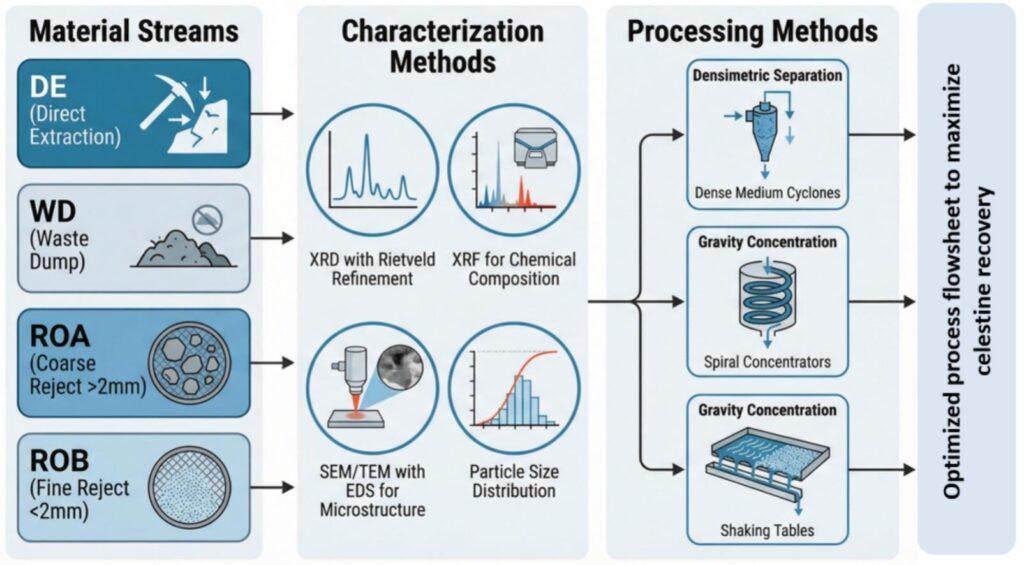
The research combined advanced mineralogical characterization techniques, including X-ray diffraction (XRD), X-ray fluorescence (XRF), scanning and transmission electron microscopy (SEM/TEM), and X-ray photoelectron spectroscopy (XPS), with process simulation tools to evaluate the performance of different gravity separation technologies. Four representative material streams from the Montevive operation were analysed, including direct extraction materials, waste dump materials and previously discarded processing fractions.
One of the most important findings of the study is the demonstration that significant quantities of valuable celestine remain present in materials that have traditionally been considered waste or low-value by-products. By applying a carefully designed combination of desliming, size classification and gravity separation technologies, the researchers showed that these resources can be effectively recovered and upgraded, contributing to a more efficient use of mineral resources and reducing the need for additional extraction.
The research evaluated the performance of dense medium cyclones, spiral concentrators and shaking tables through MODSIM™ process simulations validated with semi-industrial testing. Results showed that pre-deslimed coarse fractions achieved celestine grades of up to 96.36% in simulations and 91.40% in validation tests, demonstrating the effectiveness of optimized dense medium cyclone processing. For finer and more challenging materials, shaking tables achieved celestine grades exceeding 85%, outperforming alternative gravity separation methods.
Based on these results, the researchers developed an innovative integrated processing flowsheet capable of maximizing celestine recovery across different feed types. The proposed strategy combines multiple gravity-based technologies in a staged configuration, matching each processing route to the mineralogical and granulometric characteristics of the material. This approach enables higher concentrate quality, improved recovery rates and more efficient utilization of resources that would otherwise remain underexploited.
Beyond its direct industrial application, the study represents an important contribution to Europe’s strategic autonomy in critical raw materials. By improving the recovery of strontium from existing resources and historical waste streams, the proposed methodology supports the objectives of the European Critical Raw Materials Act, the Circular Economy Action Plan and the broader transition towards a resource-efficient and low-carbon economy.
The publication also reflects the broader ambitions of the ROTATE project. Through research, innovation and demonstration activities, ROTATE seeks to develop new solutions that increase the circularity of mineral resources, reduce waste generation and enhance the sustainability of raw material supply chains. The project’s work contributes directly to securing critical raw materials for Europe while minimizing environmental impacts and promoting more efficient resource management.
This publication marks another important milestone for the ROTATE consortium and demonstrates how Horizon Europe-funded research can generate practical solutions for some of Europe’s most pressing industrial and environmental challenges. The project team will continue to disseminate scientific results and technological developments that support the transition towards a more circular, resilient and sustainable minerals sector.